


- The 53 family caregivers in our study have logged a 95% engagement rate, due to the positive impact of the care navigation support they receive and monthly stipend they earn by participating in study activities.
- 100% of family caregivers in the study have completed the training we’ve assigned to them.
- Multiple case studies highlight emergency department (ED) visits and hospitalizations that we helped care recipients avoid, saving health plans $2,500-$15,000 per incident.
- We’re documenting, tagging, and clinically reviewing every case study in order to automate detection for similar events in the future.
In August, RubyWell and the Jewish Association on Aging (JAA) launched a Family Caregiver Study in Allegheny County, PA. The study, funded by a grant awarded to JAA by the Richard King Mellon Foundation, aims to show that giving family caregivers daily care navigation support, digestible training, and compensation helps reduce avoidable ED visits and hospitalizations. And it eases family caregiver stress.
Three months in, we’re already seeing this hypothesis play out. We have some exciting data to share. But first, let’s level-set on why lowering hospital usage matters so much to everyone involved.
Obviously, keeping care recipients out of hospitals positively impacts their physical and mental health, improves their quality of life, and lowers healthcare costs. It also reduces the risk of hospital acquired infections or other complications that may be associated with a hospital stay.
Family caregivers’ work doesn’t pause when the person they care for is in the hospital. If anything it increases, with added healthcare providers to coordinate; travel to and from the facility; added gasoline, parking, and meal costs; all while juggling the rest of their family’s needs and often a job. When their person lands in the hospital, stress levels increase, jobs and income face interruptions, their cognitive load goes up, as does their spending. All of that can negatively impact their own physical and mental health, leaving less in their tank to give to the person they care for. So they benefit greatly from keeping the hospital out of the picture.
The most quantifiable impact of reducing avoidable ED and hospital usage lands on the balance sheets of health plans. According to the CDC, 90% of Americans over 65 have at least one chronic condition. Nearly 79% have two or more. This is a key driver of the nation’s $5.3 trillion in annual healthcare costs. Patients with two or more chronic conditions account for 2-3x more hospitalizations requiring 2-4x longer stays. They also have 25% higher readmission rates.
By reducing avoidable ED and hospital usage, RubyWell’s model is designed to lower health plan costs by 40%.
Who are the study participants?
We currently have 53 families in the study, all living in Pennsylvania’s Allegheny County, which includes metropolitan Pittsburgh.
The 53 Care Recipients
34 are covered by Medicare Advantage plans
17 are covered by Original Medicare
2 have dual coverage (Medicare + Medicaid)
48 started in a home health episode at enrollment
53 have 2+ chronic conditions, most commonly:
• Hypertension
• Type 2 diabetes
• Chronic Kidney Disease
• Dementia
• Falls
Their Family Caregivers
54% are caring for their spouse
44% are caring for a parent
6 years spent caregiving, on average
What impact have we made for family caregivers?
Family caregivers are engaged and feeling the difference that consistent support, training, and compensation bring.

“I have felt supported in my role as a caregiver. The program has taught me how to better care for my husband and also how to take care of myself. I have more peace of mind knowing that I have someone to call when I need help.” - Family Caregiver caring for her husband
Confident, supported caregivers stay engaged
We expected a 75% engagement rate from our family caregivers. We’re seeing a 95% engagement rate. This looks like 224 family-initiated contacts every week.
Engagement works both ways
Our Care Navigators have caught over 500 changes in condition that family caregivers reported to them, and have initiated an average of 242 outreach calls per week.
“When I had a question on the survey and huddle, it was a 24 hour turn around to receive a response. There seems to be someone there for you when you need it and everyone has been pleasant.” - Family Caregiver caring for her husband
Payments incentivize engagement
We expected a 30% attrition rate based on a Duke University caregiver study shared by our study advisors at Integra Strategies. Our study is seeing an attrition rate of just 13%, mainly due to changes in care settings (e.g., from home to assisted living or memory care).
We believe this low attrition is due to the positive impact of the consistent care navigation support we provide and the stipend payments our family caregivers earn for participating in study activities. We’ve paid out an aggregate of $19,575 in stipend payments in the first three months. Because families joined at different times during those three months—some are onboarding as we post this—the average total payment per family caregiver has been $400 across the first three months. Maximum monthly payments for completing all weekly and monthly study activities is $300.
Health crises averted, hospitals avoided, money saved
As we gather data for overall impact, we’re collecting case studies of ED visits that we helped care recipients avoid. We’re sharing two below, with names changed to protect privacy.
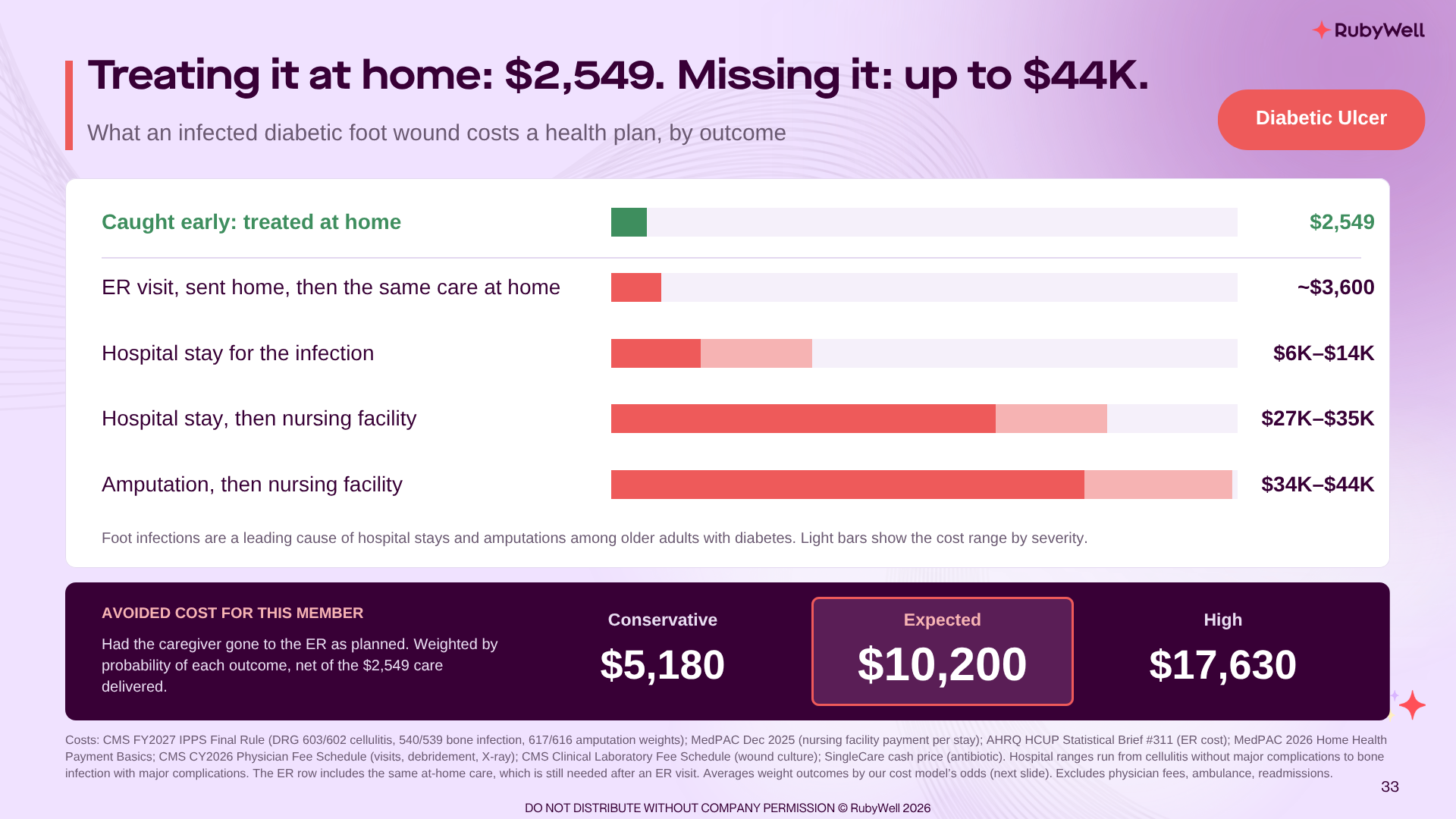
Case Study: Infected Foot Wound
Signal: Nancy finds a wound on her care recipient’s foot. She notices redness, drainage, odor, and a fever. Because the person she cares for is diabetic, she knows there’s a chance that this could lead to amputation. She tells the Care Navigator that she plans to take him to the ED.
Action: The Care Navigator arranges an urgent visit with the member’s primary care doctor, instead.
Result: The PCP cleans the wound and prescribes an antibiotic. The JAA home health nurse follows the wound care plan at home. The wound is healing. No ED or hospital was needed.
Savings: Had this care recipient gone to the ED for treatment, it would have cost the plan between $5,180 and $17,630. The PCP treating the wound and ordering a 30-day home health episode lowered treatment costs to $2,549. Missing it can cost up to $44K.
Case Study: High Blood Sugar
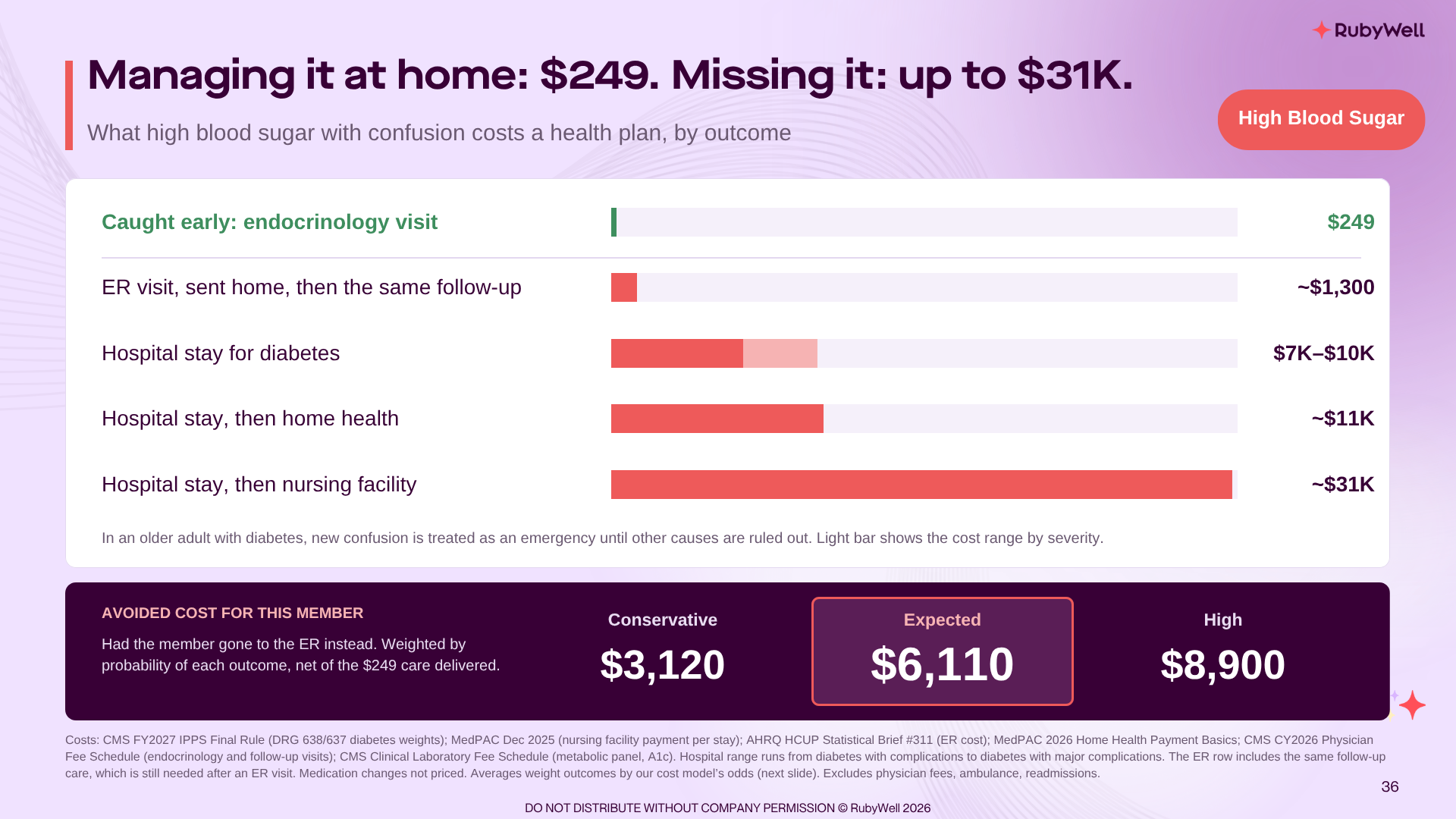
Signal: Michael notices the person he cares for is experiencing new confusion, a change that one of the training videos and our Care Navigator taught him to watch for. He checks her blood sugar: It’s elevated at 255. Michael begins to panic and calls his Care Navigator.
Action: Instead of sending them to the ED, the Care Navigator arranges an endocrinology visit for the next day.
Result: The Endocrinologist adjusts the diabetes treatment. The patient recovers at home. No ED or hospital was needed.
Savings: Had this care recipient gone to the ED for treatment, it would have cost the plan between $3,120 and $8,900. Managing it at home costs $249. Missing it can cost up to $31K.
We've also helped a family deal with a sore on the care recipient’s leg that wouldn’t heal. Our Care Navigator connected the family caregiver with the PCP who discovered an allergy to the antibiotic that had been prescribed. A treatment change is finally helping the wound heal, preventing hospitalization. We helped another family caregiver reduce the number of falls her care recipient experienced after he was discharged from the hospital, avoiding readmission.
Our team documents, tags, and clinically reviews every case where hospital usage was avoided so that we can automate detection for similar events in the future.
• Each case becomes a reviewed data point
• Cases become counts
• Our clinical reviews become models to automate detection over time
Learnings to fuel the next nine months
Structured engagement
The study is showing us that structured engagement between our Care Navigator and participants ensures early signals are noticed and acute care needs are reduced. And two-way engagement is key.
Families initiate contact Monday through Friday, via:
• Daily check-in surveys
• A weekly virtual huddle
• Text, email, or call to their Care Navigator for additional support as needed
Our Care Navigator initiates additional contact when:
• A check-in survey, huddle conversation, or other dialog flags a possible escalation
• A health situation is evolving (dr. visit confirmation, hospital discharge, etc.)
• More than two weeks have passed since she has checked in with a participant who consistently reports that all is well
This regular, proactive contact generates a huge amount of input that would otherwise slip through the cracks. Our AI platform is making it feasible to process and utilize this input, find patterns, and prioritize outreach. This allows us to scale this solution as we expand the program to health plans.
Limiting time demands
We started the study requiring family caregivers to attend two virtual huddles and submit three check-in surveys per week. Their feedback let us know that the second huddle was taking up valuable time in their day. And they suggested that they could provide the data we were collecting more efficiently via a check-in survey. So we replaced the second huddle with an additional check-in survey. We’ll be watching to see if the quantity and quality of the data we receive is impacted.
Community support
The family caregivers let us know that they were craving—and expecting—community support. So we initiated monthly virtual support groups that are led by a RubyWell team member. This fills a need for the family caregiver who often feels isolated and misunderstood. And it creates more opportunities to collect input and catch a possible health escalation early.
“It is reassuring to feel like there are others that know how hard it can be sometimes. I feel less isolated.” - Family Caregiver caring for her mother
One quarter of the way through this study, we’re seeing qualitative and quantitative benefits of supporting family caregivers. We see it in every huddle when a husband tells us he proactively requested a urinalysis for his wife who has suddenly started acting more agitated. We see it in the check-in surveys that flag a new pressure wound or blood sugar spike. We see it in the messages that family caregivers send us, just to thank us for being there when they needed us. And we look forward to seeing it in lowered healthcare spending for our future plan partners.
At RubyWell, we’re paving a path to financial stability for all family caregivers. Our Family Caregiver Study in Pennsylvania to is evaluating a new care model that helps family caregivers get the support, training, and compensation they deserve while also helping them reduce avoidable hospital usage. And our Family Leave Finder provides state-by-sate info on family leave laws. If you found this article helpful or inspiring, share it with other family caregivers or innovators in the caregiving space.

Suzanne Boutilier has been working and writing in the caregiving space since 2021. She also helps her sisters care for their aging father.

Julie is the CEO & Co-Founder of RubyWell.


